Quick Thoughts: Whose Joy is It?

lastingjoy2

“And they kept the Feast of Unleavened Bread seven days with joy, for the Lord had made them joyful and had turned the heart of the king of Assyria to them, so that he aided them in the work of the house of God, the God of Israel.” (Ezra 6:22, ESV)

Several key thoughts from this passage:

1) As students of history, we have the advantage of hindsight. We know the story and the after-story. We know, for instance, that though the Israelites responded in joy, their joy did not last. Eventually, they lapsed into rebellion again. But is this really abnormal?  Joy, for most of us, is temporary. It is a “now” emotion. It can be summoned by memory but this is only remembering joy. The experience of joy itself is always high, electric, and now. It can last for seconds or, in the case of this verse, it can last for days. But eventually, it passes. The “now” must always conclude and transition into another moment…and another…and another. And these succeeding moments may not be positive, causing us to lose the experience of joy and doubt the God that once lifted us so high.

2) There was one cause of their joy: God and God alone. God made them joyful AND He turned the heart of the king of Assyria to them. In other words, God worked on them both internally and externally to make their joy complete. He did not leave them with the temporary joy of endorphins due to the miraculous change in the political landscape. Rather, God MADE them joyful. He worked in their spirit, pointing them to a joy rooted in Him more than the kings of Earth. This is God-centered joy, the everlasting spring that pours out joy as a response to the person and work of the eternal God. And since He is eternal this joy does not fade away like historical joy.

3)  That is why we do not build a theology around the “now” moments of joy but rather around the God who completes our joy, the One to whom we can sing, “For you, O Lord, have made me glad by your work; at the works of your hands I sing for joy.” (Ps. 92:4) and the One in whom we can proclaim, even in life’s darkest moments, “The joy of the LORD is [my] strength.” (Neh. 8:10)

So, here’s my question: Where is your joy? In what or whom do you find yourself rejoicing? What makes you glad? Is it when your moments temporarily align with your agenda or will? Or is it in the eternal God who moves the hearts of His people, and of kings, to accomplish His agenda and will? Let’s be honest here. Who rules your joy? You or God?

Quick Thought: Whose Battle is It?

Ezra 5:6-17

 This is a copy of the letter that Tattenai the governor of the province Beyond the River and Shethar-bozenai and his associates, the governors who were in the province Beyond the River, sent to Darius the king.They sent him a report, in which was written as follows: “To Darius the king, all peace. Be it known to the king that we went to the province of Judah, to the house of the great God. It is being built with huge stones, and timber is laid in the walls. This work goes on diligently and prospers in their hands. Then we asked those elders and spoke to them thus: ‘Who gave you a decree to build this house and to finish this structure?’10 We also asked them their names, for your information, that we might write down the names of their leaders.[b] 11 And this was their reply to us: ‘We are the servants of the God of heaven and earth, and we are rebuilding the house that was built many years ago, which a great king of Israel built and finished. 12 But because our fathers had angered the God of heaven, he gave them into the hand of Nebuchadnezzar king of Babylon, the Chaldean, who destroyed this house and carried away the people to Babylonia. 13 However, in the first year of Cyrus king of Babylon, Cyrus the king made a decree that this house of God should be rebuilt. 14 And the gold and silver vessels of the house of God, which Nebuchadnezzar had taken out of the temple that was in Jerusalem and brought into the temple of Babylon, these Cyrus the king took out of the temple of Babylon, and they were delivered to one whose name was Sheshbazzar, whom he had made governor; 15 and he said to him, “Take these vessels, go and put them in the temple that is in Jerusalem, and let the house of God be rebuilt on its site.” 16 Then this Sheshbazzar came and laid the foundations of the house of God that is in Jerusalem, and from that time until now it has been in building, and it is not yet finished.’ 17 Therefore, if it seems good to the king, let search be made in the royal archives there in Babylon, to see whether a decree was issued by Cyrus the king for the rebuilding of this house of God in Jerusalem. And let the king send us his pleasure in this matter.” (ESV)

————————–

After years and years of rebelling against God and prophets warning what would happen if the nation of Israel did not repent, God eventually gave Israel over to their enemies and the consequences of their depraved minds. For seventy years they were captives in a foreign land. This meant that there was enough time for three or four generations of Israelites to be living side by side in captivity. This was long enough for traditions to change, religions to be forgotten, and an entire culture to be rewritten and erased from existence. But God had promised restoration to His people. And so, according to the word of Isaiah that had been spoken 150 years earlier (Isa. 44:28), Cyrus released the Jews and allowed them to begin rebuilding their city and their temple.

However, this did not go over well with the locals, and they tried to stop the massive rebuilding project that had begun in Jerusalem.

Now, at this point, we need to pause. Pull back the curtain a bit. Let’s look at this from a different historical perspective. Prior to creation, Satan attempted a coup in Heaven and failed. Although he and his followers were cast out, he just regrouped and continued the battle here on earth. Their first victory was the Fall. But the destruction of man’s purity is not the ultimate goal for Satan. Rather, realizing that he cannot compete against a holy God, his goal is to make the playing field even by removing God’s holiness. And the easiest way to accomplish this? To thwart just one of God’s promises. You see, if only one of God’s promises does not come true, then Satan has proved God to be a liar. Imperfect.  Unable to predict and navigate all the variables. In other words, finite and fallible.

So, when God begins to move history and kings in the direction of fulfilling His promise of restoration, when the walls of Jerusalem and the temple begin to be rebuilt, Satan organizes a faction of people with political clout to oppose the work. This is spiritual warfare and the stakes are much higher than a city or a building. It is the character and person of God.

It seems these Israelites knew this as well. For when their  opponents asked who they were (so they could tell the king who was “rebelling” against his kingdom), they responded that they were “servants of the God of heaven and earth.” Their focus was not on themselves, but on preserving the name of the Lord. We see this pattern repeated during many spiritual battles throughout scripture, both in the Old and the New Testaments:

In Moses’ injunction for Pharaoh to “Let My people go!”

In David’s answer to Goliath: “You come to me with a sword and with a spear and with a javelin, but I come to you in the name of the Lord of hosts, the God of the armies of Israel, whom you have defied.”

In Joshua’s challenge to the people of Israel:  “And if it is evil in your eyes to serve the Lord, choose this day whom you will serve, whether the gods your fathers served in the region beyond the River, or the gods of the Amorites in whose land you dwell. But as for me and my house, we will serve the Lord.”

In Gideon’s battle cry: “A sword for the LORD, and for Gideon!”

In the response of Shadrach, Meschach, and Abednego:  “O Nebuchadnezzar, we have no need to answer you in this matter. 17 If this be so, our God whom we serve is able to deliver us from the burning fiery furnace, and he will deliver us out of your hand, O king.[d] 18 But if not, be it known to you, O king, that we will not serve your gods or worship the golden image that you have set up.”

In Peter’s response to the Pharisees when told to stop preaching the Gospel:  “We must obey God rather than men.”

In Paul’s writing to the Corinthians: “So, whether you eat or drink, or whatever you do, do all to the glory of God.”

In James’ pleading words: “Come near to God and He will come near to you.”

And even today, when you are sitting at the dinner table, and your 17-year-old child challenges the core beliefs of your faith, or when you are at work and encouraged to compromise your values, or perhaps when you are alone, everyone else in the house is asleep, and you consider watching that internet site you shouldn’t….Whatever battle you find yourself in, whatever “king” challenges you (whether literal or metaphorical), remember:

1) “We are servants of the God of heaven and earth.” That is your starting place. This opposition is not about you. It is, ultimately, about God. You may be damaged or destroyed in the process but you are not the bullseye of this conflict. Fight not only for yourself. Fight also for God.

2) God is a god of promises. And His promises do not fail. He is not a liar, indeed He cannot lie.

3) For this reason, you can stand confidently in the promises of God.  “Fear not” should not only be an injunction of angels but also the motto for Christian living. If kings must bow to the will of God, why should we bow to kings?

 

Why I Decided to Stop Reading the Bible Every Year

fasting1When I was a teenager, I began the practice of daily Bible reading. My pattern was to read a chapter in the morning and a chapter in the evening in order to bookend my day with the thoughts of God.  Using this method allowed me to finish the Word approximately every two years. But this changed four years ago after I downloaded a Bible app to my phone. Excited with all of the functionality and options for studying that it allowed me to do, I chose to begin a new Bible reading plan, one that would allow me to read through the entire text in a single year. This meant that I would be reading four or five chapters a day from the Bible.

Admittedly, ego drove this decision more than devotion or fervency for God. I wanted to be able to say, at least to myself, that I had read through the Bible “x” number of times in my life. Something about the number made me feel good about my walk with God. In hindsight, though, this gory self-righteousness led me down a path that was neither spiritual nor helpful for my Christian life. Thus, I have decided it is time to stop reading the Bible every year. Below are my top 10 reasons why:


  1. The Bible is to be absorbed, not raced through like a NASCAR race
  2. The Bible is made for man and is best understood in small doses in order to understand its application to life, but reading through it in a year only provides a large 30,000 foot overview.
  3. The Bible is designed to reveal God but, as with all things, speed blurs perception.
  4. If I only have 20-30 minutes each morning to read my Bible, I will get more out of it by examining how this passage connects to others or meditating on a manageable bite size piece, rather than reading 4 chapters and having no time for meditation or study.
  5. The Bible is not only to be meditated upon but also applied. I cannot apply a lesson I have not taken the time to learn. Most likely the only lessons that I am “hearing” when I read through the Bible in a year are the ones I remember the Lord teaching me from the past, not new ones that challenge me.
  6. Reading it through in a year can be more about successfully accomplishing a goal than becoming closer to or more like the LORD.  If my life is to be lived in such a way so that others may see the perfections of God publicly displayed through me, then I must take the time to understand how to exalt the LORD with all of who I am. To learn how, as John the Baptist said, I must become less so that He becomes more.
  7. As Chaucer once said, “Familiarity breeds contempt.” This year I began to realize that I was reading the Bible much like a movie I have seen a hundred times, anticipating the memorable or favorite scenes, but not enjoying it. Such an exercise feels like a duty, not a relationship with the text or the Creator who wrote it.
  8. It taps into my sinful nature much more easily than I anticipated: perfectionism masquerading as holiness, self-righteousness obscuring shame, self-blame and feelings of failure when I miss days that I should have read, as well as pride in doing the safe and private task of reading instead of the dangerous task of actively serving others with the power that God provides.
  9. The Bible is to be a starting point, not an ending point, for Christian living. It points us towards God and holy living. Making our calling and election sure is more than an intellectual agreement with a specific set of teachings. It is also a daily behavior that confirms that we are Christ’s and that He is ours. That the two have become one. The choice to love God is not one we make only at a singular point in time. Rather, it is one that we continue to make throughout our lives, sometimes even several times a day, so that we may know the joy of continually turning towards each other, even when our beloved makes no sense or hurts us. In other words, it is embracing the vulnerability of love in order to gain the intimacy of relationship.
  10. Aside from the incarnation, the Bible is God’s most vulnerable expression of who He is. It is the place where He bares His heart, communicates His desires, shares the joys and sorrows of His past, explains His frustrations, and voices His profound yearning for a deeper relationship. But if I am trying to get through four or five chapters before I start my day, I will often hear His mouth, but miss the message of His heart.


What am I going to do instead? I think I will go backward in order to move forwards. Get out my pen, annotate the text, and really try to see how all the parts connect to each other. A chapter or two each day. As they say in the South, “If it ain’t broke, don’t fix it.”

The Star Trek Life

lead_960

In 1966 (a full eleven years before George Lucas reinvented the movie industry), Gene Roddenberry pitched an idea to t.v. execs that was so unusual in the day of Andy Griffith and Bonanza that he wound up describing it as the “Wagon Train of space.” In retrospect, that wasn’t a bad description as characters moved from one adventure to the next each week, but never really got anywhere. But that was okay. These people, even the strange one with the pointy ears, were relatable.

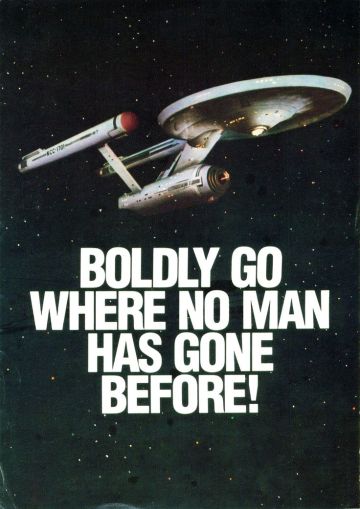
They embraced the pioneering spirit that made America great and used technology, ingenuity, and a utopian worldview in a futuristic era “to boldly go where no man has gone before.” But their lives weren’t perfect. They still struggled with the same character defects of all humans, and much like the viewers who tuned in each week, they seemed to always be teetering on the brink of war with their arch-rival, the Klingons. Ironically, after only 79 episodes, they were canceled one month before America’s pioneering spirit and advanced technology helped Neil Armstrong walk on the moon. However, when the show hit syndication in 1970 it quickly developed a rabid fan base and became a cult classic, laying the foundation for movies, animated series, and spin-offs that would so capture the imagination that in 1976 NASA eventually named its first space shuttle Enterprise.

This year Star Trek should be getting its AARP card any day as it hits the half-century mark. As a writer, I cannot overstate how impressive this is to me. To have a television series ingrain itself so firmly into the psyche of a culture and a genre that it persists to 50 years old is not just hitting a home run. It is tantamount to hitting the ball out of the ballpark and across the parking lot. Granted, it doesn’t hold a candle to the longevity of Shakespeare (who recently celebrated his 400th birthday), but come on. We’re talking about television here.

Still, Star Trek has left such an indelible mark on us science fiction fans that filtering our lives through the following phrases is futile to resist (see what I did there?) :

1.

b0c0b62edd3dd45c053904b837d9b8e0

When I was a child my father always emphasized to me that one choice, even a minor one, can forever change the course of a man’s life. At the time, I thought he was being melodramatic so that I would incorporate wisdom into my daily decisions. But as I have aged and have become a father of two sons myself, I realized that this is not melodrama at all. The true measure of a man lies not only in the wisdom he exercises but also in the boldness that follows that wisdom. Unfortunately, most people opt for comfort, sameness, and the familiar because they are unwilling to let go of what they know so that they can exchange it for the possibility and freedom of the unknown. Unless it is immoral or illegal, do yourself a favor: count the cost that your decision will demand of you, clip the cord of fear that holds the “what” and the “if” together, and boldly go where you have never gone before.

2.

hqdefault

We like to think of ourselves as the heroes of our own stories. The indefatigable survivors who through luck and ingenuity escape each successive trial and eventually overcome the evil that is facing us.

But that is not always the case.

Sometimes when we boldly go we must be willing to admit that we may never return. We may not be the Kirk, or the McCoy, or the Picard. We may be … a Redshirt. You know who I’m talking about. Like all members of the Enterprise, the Redshirts also boldly went where no man has gone before. But his was always a tragic end. He was that inevitably expendable member of the landing party whose death exposed the present danger and paved the way for success in the lives of his companions.

As we boldly go, we must ask: Am I willing to make the ultimate sacrifice so that the cause may be accomplished or that others may be protected?

We must realize that not all of us will see the end of the journey. But we are no less a valuable member of the team. Even Spock, one of the most beloved characters of the franchise, once sacrificed himself because “The needs of the many outweigh the needs of the few…or the one.”

You must ask yourself: Am I willing to do the same? Or am I just boldly going for the glory?

3.

s-l300

Leonard Nimoy made no secret of the fact that he tweaked a Hebrew blessing he had learned from his childhood to give us this popular Vulcan saying. But whether one is boldly going in this world or in another, it is important to always remember to bless those who share the journey with you.

Sometimes we can get so caught up in what we are doing we forget to nurture the relationships around us. To look out for who they are. To have their best interests at heart.  To make their priorities our own. And, if we are in a position in which we cannot do anything physical or material for them, then we ought to pray daily for them, interceding on their behalf.

May we use “Live long and prosper” not only as a blessing but also as a way of reminding those with whom we share our journey that long life and prosperity are often more about quality than quantity. This is not an injunction to extend life or wealth. It is an encouragement to seek wisdom, practice selflessness, and live a life worth emulating. May we provide such a powerful example of all these characteristics and more that others will understand how to pass this blessing on to those who come after us.

4.

jean-luc-picard-engage

No plan is a good one unless we put it into action. That is why we must all follow the advice of Captain Jean-Luc Picard and continually give the command to “Engage!” We cannot be thinkers only. We must be doers as well.

It is too easy to procrastinate because of fear. But the command to “Engage!” or “Make it so!” (another Picard favorite) are not the words of the most clever, best prepared, or least fearful person. Rather, they are the words of someone unafraid to risk maintaining the status quo. They understand that if given time a better plan may develop, but right now is not the time for thinking. Now is the time for doing so that great things can be accomplished.

Make your life full of engagement. Do not hold back, wondering, craving, or hoping that something will change. That is a passive approach to living, an unwillingness to accept responsibility for your own self and a hope that someone will fix your problems for you. Engage life! You may not have the best solution, but that’s okay. An active approach to your problems is always better than waiting for the current to change. Put your plans into action. Set your course. Activate the warp drive, and accelerate towards a future of unimaginable adventures. Make it so!

A Competition of Names

I am standing in a big bookstore, usually some large chain, like a Barnes and Noble, hovering around the periphery of the bestseller shelves. Customers come and go, but then one person catches my eye. She reaches over and pulls a title off the shelf, examines the cover art, and then opens the book.  Unlike the people who have come before her, she takes her time, beginning with the copyright page, the table of contents, the dedication, and then the first few pages of what she is holding. For a moment, she stands there, slowly turning the pages, until finally, with her eyes remaining in the book, her feet direct her to a nearby La-Z-Boy, and she sits down. The aura of sacredness surrounds her as she allows the words to draw her into a new reality. I feel guilty as I casually approach. Continue reading

Perfection

Ok. It’s been waaaay too long since I posted something. I am not trying to be neglectful of my blog. In fact, I have been working on a post for the last four weeks that I thought would be easy to write. Maybe you know the feeling. You see a truth you had never seen before and ideas for a post fly around the brain like unfettered popcorn.

But when you see sit down to write, the article will not develop. You attack it from as many angles as you can: humorous, honest, theological, apologetic, casual…. None of them work. You want the world to know what you have discovered. You want it to change their lives as much as it is changing yours. So, in your zeal, you break the cardinal rule of writing and share your truth verbally with people. Surprisingly, this works. You find that you can articulate the truth out loud, but when you sit down to write again…nothing comes. For a while, you consider making the post a vlog. Not an original idea, but perhaps it will allow you to at least share what you wanted to say.

Then you realize you have no idea how to post that to WordPress. So, you go back to writing.

Still, the article frustrates you like continually buffering wifi signal. You almost give up but decide that it’s a matter of principle now. You are going to figure this post out if it kills you.

You feel guilty that you haven’t posted anything in a month, and begin to wonder if you can use any of your past writings to cover the gap while you continue to work. Then you run across an old devotional that you had written for your church half a decade ago. It’s short but poignant. It speaks to only one of the issues holding you back with the original article, but it is worth sharing, nonetheless.

So, consider this my apology for being so quiet lately. I hope you like the devotional below as much as I enjoyed writing it years ago.

I’ll be back later with the other article. I cannot give up. I will not lose.

Enjoy:

“Be perfect, therefore, as your heavenly Father is perfect.” (Matthew 5:48)


When God becomes the ruler by which we measure our perfection, our entire perspective changes.  We suddenly realize that all of our rationalizations for good behavior have failed us, and our efforts to succeed without God are useless.  Our sinful self condemned us to God’s judgment, and it cannot, on its own, rescue us from judgment.  There must be a death to self that occurs.  We need the life of Christ to inhabit us so that we may become like Him.  Unless we submit ourselves to God by sacrificing our lives for God we will never succeed in our striving to be like God.

Lessons from Proverbs 10

Throughout scripture we are told to pursue wisdom and to ask for it. But Proverbs 10 goes a little deeper and gives us a comparison/contrast between the person who is wise and the one who is foolish.

Wisdom/Righteousness

Foolishness/Wickedness

Brings joy to the Father Brings grief to Mother
Delivers from death Ill-gotten treasures are of no value
God does not let go hungry God thwarts their cravings
Diligent yields wealth Laziness yields poverty
Gathers crops at proper time Sleeps during the harvest (disgraceful)
Blessings crown their head Violence overwhelms their mouth
Their memory is a blessing The name will rot
Accepts commands Comes to ruin
Walks securely due to integrity Takes crooked paths and is found out, causes grief
Mouth is a fountain of life Violence overwhelms their mouth
Love covers over all wrongs Hatred stirs up dissensions
Discerning Lacks judgment
Stores up knowledge Mouth invites ruin
Wages bring them life Income brings them punishment
Heeds discipline and shows the way to life Ignores correction and leads others astray
Holds his tongue Conceals his hatred, lying lips, spreads slander, uses lots of words
Tongue is choice silver Heart is of little value
Lips nourish many  Die for lack of judgment
Delights in wisdom Finds pleasure in evil conduct
Given what he desires Overtaken by what he dreads
Stands firm forever Swept away by the storm
Fears the Lord, long life Years cut short
Their prospect is joy Their hope comes to nothing
The way of the Lord is a refuge The way of the Lord is a ruin
Will never be uprooted Will not remain in the land
Mouth brings forth wisdom Perverse tongue will be cut out
Lips know what is fitting Mouth knows only what is perverse

Now, instead of asking yourself which column best describes you, ask God to reveal to you the true state of your heart and how you may develop and display His wisdom in your life.

Fighting Entropy


6fe1e4ce5b394a0dca617ea492dea9cf

We did not give in to them for a moment, so that the truth of the gospel might remain with you. (Gal 2:5)

Houses are always going up for sale in my neighborhood, so when I first saw it, I assumed it was just another advertisement. But as I focused, I realized the color was wrong. White background. Big red letters that were empty and stretched at the ends of the s’s.

I stopped, stretched my neck forward and squinted.

Did that say, “Star Wars”? Continue reading

200 Words or Less: Unchanging

wpid-wp-1440786307619.jpegAs a psychotherapist I have people come into my office every day asking me to advise, guide, teach, or plan a way out of their problems.  Generally I try to give practical solutions.  But for those whose problems defy practicality I try to remind them that, regardless of the situation, it is not power, or strength, or wisdom that protects these followers of God.  It is God’s immutable nature.  He has provided grace to them in the past; therefore grace is guaranteed to them in their future.  He may not always act the same, but He will always be the same.  He will comfort the depressed.  He will provide for the financially burdened.  He will sustain the despairing.  He will bind up the wounded.  Therefore let all who follow Him confidently proclaim, “The Lord does not change; therefore, [I] will not be destroyed.”